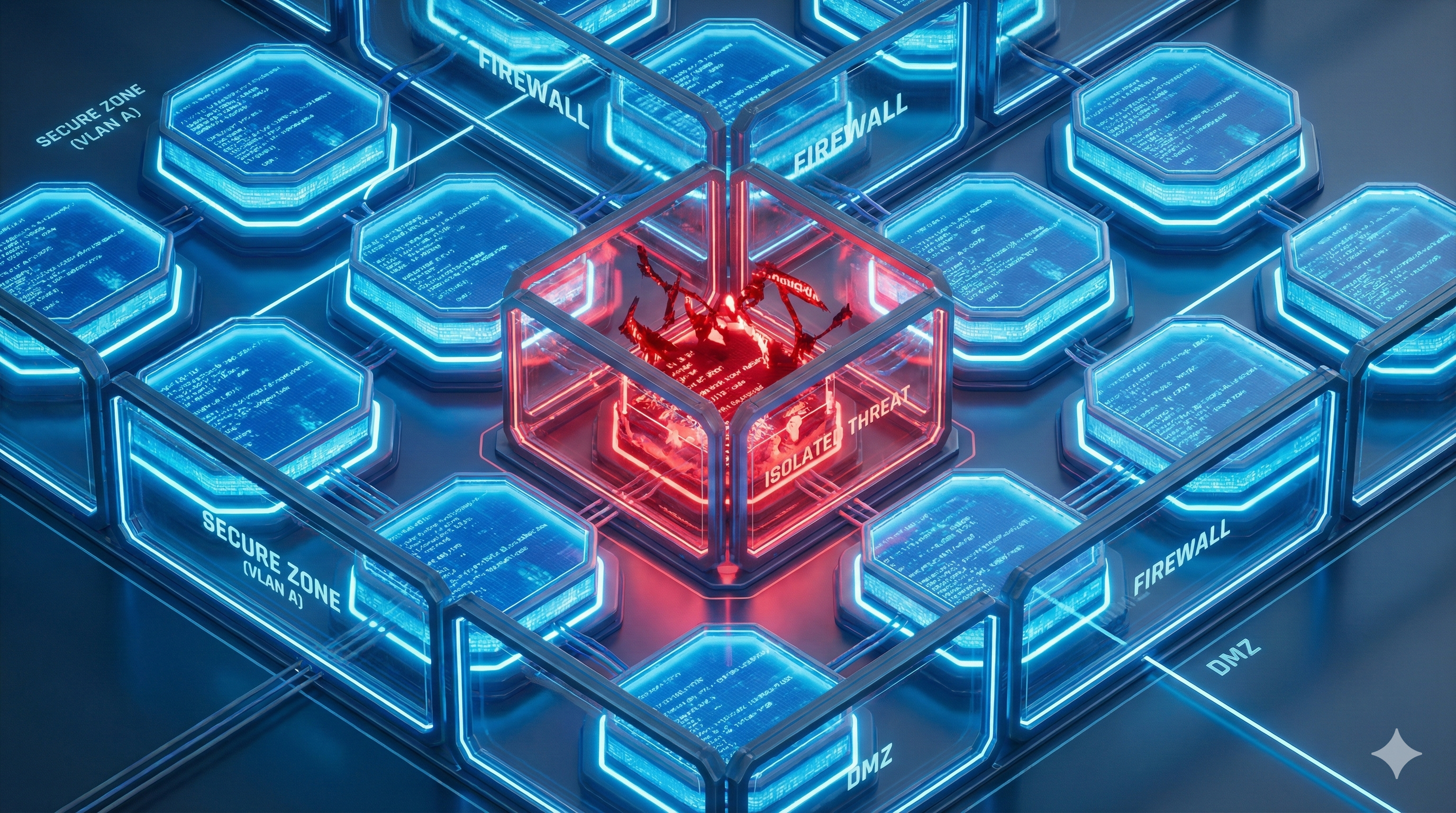
Flat Networks: The Convenient Trap
"Flat" is trendy: flat rates, flat hierarchies, flat-screen TVs. But flat networks? In modern IT security, that's an absurdity – a dangerous relic from the early days of network technology that no longer has any justification. And yet: we repeatedly encounter companies – especially in the SMB sector and in Operational Technology (OT) – that still rely on flat network designs.
A flat network architecture is an IT environment where all devices communicate in the same network segment without internal boundaries or subnets – a paradise for attackers, a ticking time bomb for businesses.
What is a Flat Network Architecture?
Flat Network: A network design where all hosts exist in the same logical network – typically a single VLAN, a large IP subnet (e.g., 10.0.0.0/16), without firewalls, ACLs, or routing between segments.
Characteristics:
- 🌐 No segmentation: All devices can see each other
- 🔓 No internal firewalls: Traffic between hosts is unfiltered
- 📡 Broadcast domain = entire network: ARP, DHCP, NetBIOS broadcasts flood the network
- ⚠️ No zone separation: Production systems, guests, IoT, OT – all in one network
Sounds simple? It is. Too simple. And that's exactly the problem.
Why Do Flat Networks Still Exist in 2025?
The Reasons – and Why They No Longer Apply
1. Historically Grown ("It's Always Been This Way")
Scenario: A company was set up in 1995 with a /16 network. New devices were simply added. 30 years later: 2,000 hosts in one VLAN.
Problem: A ransomware infection on a client PC can spread to all servers, IoT devices, and printers within minutes.
Solution: Migration to a segmented architecture – yes, it's work, but essential.
2. Re-IP Effort Seems Too High
Argument: "We would have to re-address 500 servers, that takes months and causes downtime."
Reality: With modern IPAM (IP Address Management), automation (Ansible, Terraform), and good planning, migration is feasible – and significantly cheaper than a single successful cyberattack.
Cost-Benefit Calculation:
- Segmentation costs: 50-200k € (depending on size)
- Ransomware attack costs: 1-10 million € (downtime, recovery, ransom, reputation)
3. OT Networks ("But It's Isolated")
Myth: Operational Technology (production, SCADA, ICS) is separated from the IT network, so a flat OT architecture is acceptable.
Truth:
- 90% of OT environments today have IT connections (remote maintenance, MES integration, cloud monitoring)
- A compromised engineering workstation can perform lateral movement throughout the entire OT environment
- ICS security standards like IEC 62443 explicitly require segmentation (Defense in Depth)
4. Small Businesses ("We're Not a Worthwhile Target")
Misconception: "We're too small, hackers aren't interested in us."
Reality:
- Automated ransomware campaigns make no distinction between SMBs and corporations
- 43% of all cyberattacks target small businesses (Verizon DBIR)
- Supply chain attacks use small suppliers as entry points to larger targets
The Risks of Flat Networks: Lateral Movement Paradise
1. Unrestricted Lateral Movement
Problem: An attacker who compromises any host (e.g., via phishing) can reach any other host in the network from there – without firewall hurdles.
Attack Chain Example:
- 🎣 Phishing email → Employee opens malware
- 💻 Client PC infected (e.g., 10.0.5.123)
- 🔍 Network scan:
nmap 10.0.0.0/16→ finds 2,000 hosts - 🎯 SMB exploits against Windows servers (e.g., EternalBlue)
- 🔓 Credential harvesting with Mimikatz
- 👑 Domain Admin access within 2 hours
- 🔒 Ransomware deployment to all servers simultaneously
In segmented networks: The attacker would be trapped in the client VLAN. Access to server segments would require firewall bypass → significantly higher effort.
2. Broadcast Storms & Performance Issues
Problem: All hosts in a broadcast domain receive all broadcasts (ARP, DHCP, NetBIOS, mDNS).
Impact:
- With 1,000+ hosts: Significant overhead → network performance degradation
- Broadcast amplification attacks can bring down the entire network
- Debugging network problems becomes nearly impossible
3. Missing Monitoring Chokepoints
Problem: In a flat network, there are no central monitoring points (firewalls, routers) where traffic can be inspected.
Consequence:
- ❌ No inline IDS/IPS between client and server segments
- ❌ No NetFlow/IPFIX for traffic analysis
- ❌ No central logging of access patterns
- ❌ Detection of lateral movement nearly impossible
Best Practice: Firewalls between segments as monitoring chokepoints → all flows are logged, anomalous patterns detectable.
4. Compliance Violations
Many compliance frameworks explicitly require segmentation:
- 🏅 ISO 27001: A.13.1.3 – "Segregation in networks"
- 💳 PCI-DSS: Requirement 1.2 – "Build firewall configuration to restrict traffic between cardholder data and untrusted networks"
- 📋 KRITIS/NIS2: "State of the Art" security includes network segmentation
- 🏭 IEC 62443 (ICS): "Defense in Depth" with zone segmentation
Audit Fail Risk: Flat networks will very likely result in non-compliance findings.
5. Missing Access Control & Least Privilege
Principle: Least Privilege means that every user/process only has access to the resources they actually need.
In Flat Networks:
- Every client can contact every server
- IoT devices (smart TVs, printers) have full access to file servers
- Guest WiFi (if separated at all) can access internal resources
Best Practice: Micro-segmentation with Zero Trust model – only explicitly allowed flows are possible.
Network Segmentation: Strategies & Best Practices
1. VLAN-Based Segmentation (Layer 2/3)
Concept
Dividing the network into logical VLANs, separated by Layer 3 firewalls/routers.
Typical Segments:
- 🖥️ User VLAN: Client PCs, laptops
- 🖨️ Printer VLAN: Printers, scanners, copiers
- 🔒 Server VLAN: File servers, application servers
- 💾 Database VLAN: Database servers (highest isolation)
- 📱 IoT VLAN: Smart building, IP cameras, sensors
- 👥 Guest VLAN: Visitor WiFi (internet-only)
- 🏭 OT VLAN: Production systems, SCADA
- ⚙️ Management VLAN: Server ILO/iDRAC, switch management
Firewall Rules Between Segments:
# Example: User-VLAN → Server-VLAN
Allow User-VLAN → Server-VLAN: TCP/443 (HTTPS), TCP/445 (SMB)
Deny User-VLAN → Server-VLAN: */* (Default Deny)

# Example: IoT-VLAN → Internet
Allow IoT-VLAN → Internet: TCP/443, UDP/53
Deny IoT-VLAN → ANY_INTERNAL: */* (IoT must not access internal resources)
Advantages:
- ✅ Lateral movement restricted
- ✅ Central monitoring chokepoints (firewall logs)
- ✅ Performance improvement (smaller broadcast domains)
- ✅ Compliance conformity
Challenges:
- ⚠️ Initial re-IP effort
- ⚠️ Firewall rule management overhead
- ⚠️ Potential misconfigurations (overly permissive rules)
2. Micro-Segmentation (Software-Defined)
Concept
Granular segmentation at workload level (not just subnets), typically via Software-Defined Networking (SDN) or host-based firewalls.
Technologies:
- 🔷 VMware NSX: Micro-segmentation in virtualized environments
- ☁️ Cloud-Native: AWS Security Groups, Azure NSGs, GCP Firewall Rules
- 🐳 Container Networks: Kubernetes Network Policies, Istio Service Mesh
- 🛡️ Zero Trust Platforms: Palo Alto Prisma, Zscaler Private Access, Illumio
Example: Zero Trust Policy for Database Server
# Policy: Only application servers may access DB server
Source: App-Server-Group (Tag: app=backend)
Destination: DB-Server-Group (Tag: tier=database)
Protocol: TCP/3306 (MySQL)
Identity: Service-Account "app-backend-sa"

# All other access: DENY (Default Deny)
Advantages:
- ✅ Granular policies (workload-to-workload, not just subnet-to-subnet)
- ✅ No physical network restructuring required
- ✅ Automated policy enforcement (tag-based)
- ✅ Ideal for cloud & container environments
Challenges:
- ⚠️ Higher complexity (new tools, new skills)
- ⚠️ License costs for commercial platforms
- ⚠️ Potential performance overhead (host-based filtering)
3. Defense-in-Depth: Multi-Layer Segmentation
Concept
Combined strategy of physical/VLAN segmentation, firewalls, IDS/IPS, application layer controls.
Layer Model:
| Layer | Technology | Function |
|---|---|---|
| Perimeter | Next-Gen Firewall (NGFW) | Internet boundary, IPS, URL filter |
| DMZ | Separate zone for public servers | Web server, mail gateway isolated |
| Internal Zones | VLAN segmentation + internal firewalls | User/server/IoT/OT separation |
| Micro-Segmentation | Software-defined policies | Workload-to-workload control |
| Endpoint | EDR, host-based firewall | Process-level control on hosts |
| Application | WAF, API Gateway | Layer 7 security (HTTP, HTTPS) |
Principle:
Multiple independent security layers → if one layer fails, the next one stops the attacker.
Migration from Flat to Segmented Networks: Practical Roadmap
Phase 1: Assessment & Planning (4-6 Weeks)
Tasks:
- Inventory: Complete inventory of all network devices, IP addresses, services
- Tools: Nmap, Nessus, IPAM software, switch port scans
- Traffic Analysis: Which systems communicate with each other? (NetFlow/sFlow over 2-4 weeks)
- Goal: Identify dependencies (app server → DB server, clients → file server)
- Segmentation Design: Logical grouping into zones
- Rule of thumb: 5-15 segments depending on company size
- IP Address Schema: New IP schema with clear ranges per segment
- Example: 10.10.0.0/16 User, 10.20.0.0/16 Server, 10.30.0.0/16 IoT
- Firewall Rules (Draft): Basic ruleset based on traffic analysis
Deliverables:
- 📄 Network segmentation design document
- 📊 Firewall rule matrix (source → destination → ports)
- 🗓️ Migration schedule with downtime windows
- 📋 Rollback plan
Phase 2: Pilot Segment (2-4 Weeks)
Strategy:
Start with a non-critical segment as proof of concept.
Recommendation: Start with IoT VLAN
- ✅ Low risk (no critical business apps)
- ✅ High security impact (IoT devices are often vulnerable)
- ✅ Simple rule: IoT → Internet (HTTPS/DNS), IoT → Internal (DENY)
Procedure:
- Create VLAN 30 (IoT)
- Set up DHCP scope for 10.30.0.0/24
- Gradually move IoT devices (reconfigure ports on switches)
- Test firewall rules between IoT VLAN and rest
- Monitoring: Are all IoT functions intact? (Cloud connectivity, updates)
Document Lessons Learned:
What unexpected dependencies were there? How long did migration take per device?
Phase 3: Critical Segments (Iterative, 3-12 Months)
Prioritization:
- User VLAN: Isolate clients (highest phishing risk)
- Guest VLAN: Completely separate visitor WiFi from internal
- Server VLAN: File servers, application servers
- Database VLAN: Databases (highest isolation)
- OT VLAN: Production environment (if applicable)
Per Segment:
- 📋 Create detailed runbook
- 🧪 Test in staging environment (if possible)
- 📅 Downtime window (typically weekend/night)
- 👥 Rollout team (network, server, security, support)
- 📞 Hotline for user support (during user VLAN migration)
Pitfall: Firewall Rules Too Restrictive
Problem: "We blocked everything and now nothing works anymore."
Solution:
- Start with permissive rules: Initial phase: Allow most, only deny critical flows (e.g., IoT → Server)
- Monitoring: Analyze firewall logs for 2-4 weeks → which flows are actually being used?
- Iterative hardening: Gradually make rules more restrictive based on actual traffic patterns
Phase 4: Continuous Improvement (Ongoing)
Measures:
- 📊 Quarterly rule reviews: Are all rules still necessary? Can we become more restrictive?
- 🔍 Anomaly detection: SIEM rules for unusual inter-segment traffic
- 🧪 Pentests: Regular penetration tests to validate segmentation
- 📚 Documentation: Keep firewall rule documentation up to date
Zero Trust: The Future of Network Security
Zero Trust Principles
Core Idea: "Never trust, always verify" – no implicit trust based on network location.
The 5 Pillars of Zero Trust:
- Verify Explicitly: Authentication & authorization based on identity, device health, location, etc.
- Least Privilege Access: Just-in-time & just-enough access
- Assume Breach: Design under the assumption that attackers are already in the network
- Micro-Segmentation: Granular workload-to-workload isolation
- Continuous Monitoring: Real-time analysis of all access
Zero Trust ≠ End of Network Segmentation
A common misconception: "With Zero Trust, we no longer need network segmentation."
Truth: Zero Trust complements network segmentation, it doesn't replace it.
| Aspect | Network Segmentation | Zero Trust (Micro-Segmentation) |
|---|---|---|
| Granularity | Subnet/VLAN level (e.g., all servers in 10.20.0.0/24) | Workload level (e.g., only App-Server-Pod A → DB-Server-Pod B) |
| Identity Awareness | No (IP-based) | Yes (user, device, service account) |
| Dynamics | Static (rules rarely change) | Dynamic (policies based on context) |
| Complexity | Medium | High |
| Best Use Case | Defense-in-depth, compliance, broadcast isolation | Cloud-native apps, containers, least privilege |
Recommendation: Hybrid approach – VLAN segmentation as foundation, Zero Trust policies on top.
Conclusion: Flat Networks Have No Future
The times when flat networks were acceptable as a "convenient solution" are over. In a world with automated ransomware campaigns, supply chain attacks, and advanced persistent threats (APTs), a segmented network architecture is not optional – it is essential.
Key Takeaways
- 🚫 Flat Networks = Lateral Movement Paradise: One compromised host = access to all systems
- 🛡️ Segmentation is Defense-in-Depth: Multiple security layers exponentially increase resilience
- 📋 Compliance Requires Segmentation: ISO 27001, PCI-DSS, KRITIS/NIS2 explicitly require zone separation
- ⚡ Migration is Achievable: With good planning, pilot segments, and iterative rollout, the transition is realistic
- 🔮 Zero Trust is the Future: But even Zero Trust needs network segmentation as a foundation
- 💰 ROI is Positive: Segmentation costs << costs of a successful cyberattack
The question is not "Should we segment?" but "How quickly can we start?"
Support with Network Segmentation
Still running a flat network or your segmentation no longer meets modern standards? Our experts support you with:
- ✅ Network security assessments & architecture reviews
- ✅ Segmentation design & migration roadmap
- ✅ Penetration testing to validate segmentation
- ✅ Zero Trust architecture consulting
- ✅ Hands-on migration support
Sources and References
- Palo Alto Networks – What Is Network Segmentation?
- Tufin – Navigating the Perils of Flat Network Security Risks
- Tufin – Zero Trust vs Micro-Segmentation
- Nile – Zero Trust Network Segmentation Guide
- Owl Cyber Defense – Network Segmentation in Zero Trust
- Verizon Data Breach Investigations Report (DBIR) – Annual Security Statistics