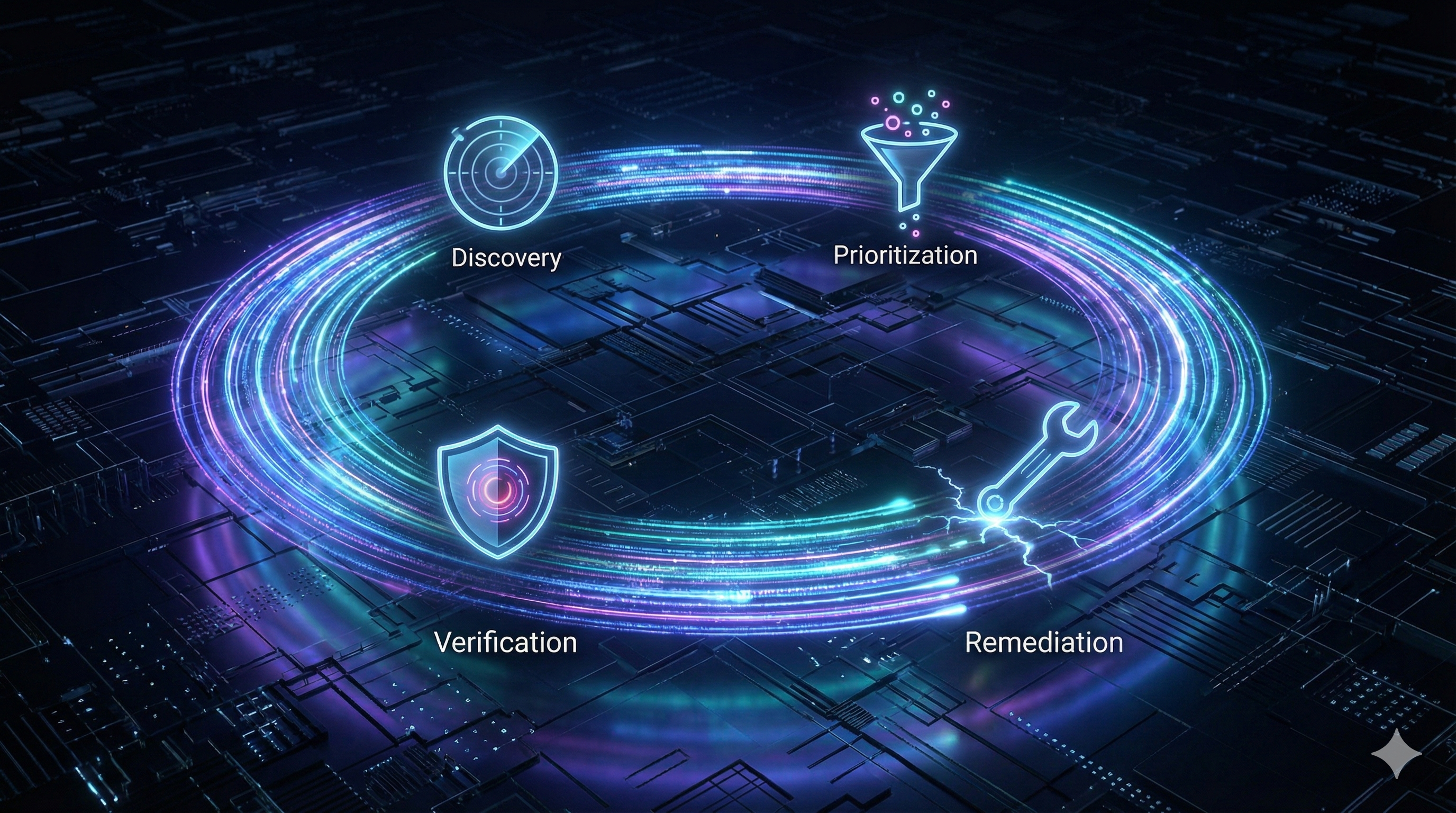
What is Vulnerability Management?
Vulnerability Management is a continuous process for identifying, assessing, prioritizing, and remediating security gaps in IT systems, applications, and networks.
Unlike point-in-time security audits or occasional penetration tests, vulnerability management is an ongoing, operational process that becomes part of daily security operations.
Why is Vulnerability Management so Critical?
The attack surface of modern organizations is growing exponentially:
- Cloud infrastructures with dynamic workloads
- Containers and microservices
- IoT devices and OT systems
- Remote workplaces and BYOD
- Third-party software and open-source components
Each of these components can contain vulnerabilities. Without systematic management, you lose visibility - and attackers exploit exactly that.
The 5-Phase Process: Vulnerability Management Lifecycle
Effective vulnerability management follows a structured cycle that is continuously repeated:
Phase 1: Discover
You can't fix vulnerabilities you don't know about. The first phase is therefore: Achieve complete visibility over all assets.
What's included?
- Asset Discovery: Which systems, applications, devices exist in your environment?
- Automated Scanning: Regular (ideally daily) vulnerability scans
- Attack Surface Management: Also identify external, exposed assets
- Code-to-Cloud Coverage: From source code through containers to production environment
Tools & Technologies:
- Vulnerability Scanners (Nessus, Qualys, Rapid7, OpenVAS)
- Configuration Management Databases (CMDB)
- Network Discovery Tools
- Cloud Security Posture Management (CSPM)
Phase 2: Prioritize
After a typical vulnerability scan, you're sitting on hundreds, sometimes thousands of findings. Impossible to fix everything immediately. The art lies in risk-based prioritization.
Prioritization Dimensions:
- CVSS Score (Common Vulnerability Scoring System): Technical severity of the vulnerability (0-10)
- Critical: 9.0-10.0
- High: 7.0-8.9
- Medium: 4.0-6.9
- Low: 0.1-3.9
- Asset Context: How critical is the affected system?
- Does it process sensitive data?
- Is it publicly exposed?
- How high would the business impact be if compromised?
- Exploit Availability: Do public exploits exist? (Check CISA KEV list)
- Threat Intelligence: Is the vulnerability being actively exploited in the wild?
- Compensating Controls: Are there already protective mechanisms (WAF, IPS)?
Modern Approaches: EPSS (Exploit Prediction Scoring System)
CVSS alone isn't enough. EPSS calculates the probability that a vulnerability will be exploited in the next 30 days. The combination of CVSS (severity) and EPSS (probability) provides a more realistic risk picture.
Prioritization Matrix Example
| CVSS | Asset Criticality | Exploit Available? | Priority | SLA |
|---|---|---|---|---|
| Critical (9-10) | High | Yes | P0 - Critical | 24 hours |
| High (7-8.9) | High | Yes | P1 - Urgent | 7 days |
| Critical (9-10) | Medium | No | P2 - High | 30 days |
| Medium (4-6.9) | Low | No | P3 - Normal | 90 days |
Phase 3: Report
Effective vulnerability management requires transparency - across all stakeholder levels.
Reporting for different audiences:
- Security Teams: Detailed technical reports with CVE numbers, affected hosts, remediation guidance
- IT Operations: Prioritized patching lists with clear responsibilities
- Compliance/Audit: Evidence for ISO 27001, PCI-DSS, SOC 2, NIS2, BSI IT-Grundschutz
- Management/Board: High-level KPIs, trend analyses, risk scores
Key Metrics:
- Mean Time to Detect (MTTD): How quickly are new vulnerabilities identified?
- Mean Time to Remediate (MTTR): How long does it take to fix?
- Vulnerability Density: Average number of vulnerabilities per asset
- Patch Compliance Rate: % of systems with current patches
- Critical/High Exposure: Number of unresolved critical vulnerabilities
Phase 4: Remediate
The heart of the process: actually closing vulnerabilities. There are several strategies:
1. Patching (most common solution)
- Automated patch deployments for standard systems
- Staged rollouts: Test → Staging → Production
- Emergency patching for zero-days
- Maintenance windows for critical systems
2. Configuration Changes (when no patch available)
- Disable unnecessary services
- Tighten access controls
- Network segmentation
3. Compensating Controls (temporary)
- Web Application Firewall (WAF) rules
- Intrusion Prevention System (IPS) signatures
- Virtual patching
4. Risk Acceptance (conscious decision)
- Legacy systems that cannot be patched
- Documented exceptions with compensating measures
- Time-limited acceptance with review cycle
Phase 5: Verify
Trust is good, verification is better. After remediation, it must be verified that the vulnerability is actually fixed.
Verification Methods:
- Re-Scan: Automated scan of the patched system
- Manual Validation: Random manual verification
- Breach & Attack Simulation (BAS): Simulation of an exploit against the hardened system
- Continuous Validation: Ongoing monitoring whether vulnerabilities reappear (e.g., through rollbacks)
After successful verification, the circle closes - and the cycle begins again with new asset discovery.
VMaaS: Vulnerability Management as a Service
Not every organization has the resources to build an internal vulnerability management program. This is where VMaaS comes in.
What does VMaaS offer?
- Managed Scanning: Regular automated scans by external security experts
- Expert Analysis: Manual verification, false-positive filtering, context assessment
- Prioritized Remediation Guidance: Concrete action instructions instead of generic CVE lists
- Compliance Reporting: Pre-configured reports for common standards (ISO 27001, PCI-DSS, TISAX)
- 24/7 Monitoring: Alerts for newly discovered critical vulnerabilities
- Flexible Terms: Monthly cancellation option, no lock-in contracts
VMaaS in the Cloud: Special Challenges
Cloud environments pose specific requirements:
- Ephemeral Workloads: Containers live only minutes - classic scans fall short
- Infrastructure as Code (IaC): Vulnerabilities arise already in Terraform/CloudFormation templates
- Shared Responsibility: What do I need to patch, what does the cloud provider patch?
- Multi-Cloud: Different scanners for AWS, Azure, GCP
Modern Solution: Cloud-Native VM Tools
- Runtime protection for containers (Falco, Sysdig)
- Image scanning in CI/CD pipelines (Trivy, Snyk, Aqua)
- Cloud Security Posture Management (Wiz, Orca, Prisma Cloud)
VMaaS for M&A: Security Due Diligence
Before company acquisitions or mergers, a security assessment is mandatory. Vulnerability management plays a central role:
Typical M&A VM Process:
- Pre-Signing Phase: Initial assessment of the target company
- External scans (without insider access)
- OSINT analysis (Shodan, GreyNoise, CVE databases)
- High-level risk assessment
- Post-Signing, Pre-Closing: Detailed internal scan
- Complete network and asset discovery
- Vulnerability assessment of all systems
- Identification of critical findings
- Cost estimate for remediation
- Post-Closing: Integration and remediation
- Prioritized remediation of critical vulnerabilities
- Harmonization of security baselines
- Integration into company-wide VM program
A structured VM assessment can influence purchase prices - when serious security gaps are discovered, risk increases (and value decreases).
Best Practices for Successful Vulnerability Management
1. Automation is Mandatory, Not Optional
Manual processes don't scale. Automate:
- Asset Discovery
- Vulnerability Scanning
- Patch Deployments (at least for standard systems)
- Reporting
2. Integration into DevOps / DevSecOps
Fix vulnerabilities as early as possible in the lifecycle:
- SAST (Static Application Security Testing) in development
- Container scanning before deployment
- IaC scanning (Infrastructure as Code)
- Security gates in CI/CD pipelines
3. Establish Clear Ownership
Vulnerability reports are useless if no one is responsible:
- Define clear responsibilities (Security, IT-Ops, Development)
- Implement SLAs for remediation
- Escalation processes for overdue fixes
4. Context Over Quantity
A report with 5,000 vulnerabilities overwhelms any team. Prioritize ruthlessly:
- Focus on exploitable vulnerabilities
- Filter false positives
- Contextual assessment (CVSS + EPSS + Asset Context)
5. Continuous Threat Exposure Monitoring (CTEM)
Static scans aren't enough. Integrate:
- Continuous Monitoring
- Breach & Attack Simulation
- Attack Path Analysis (How could an attacker chain vulnerabilities?)
6. Measure & Improve
What isn't measured isn't improved:
- Define KPIs (MTTD, MTTR, Patch Compliance Rate)
- Monthly trend analyses
- Benchmarking against industry standards
Common Mistakes and How to Avoid Them
Mistake 1: "Scan & Forget"
Problem: Scans run, reports are generated - but nobody acts.
Solution: Define SLAs and automated escalations. A critical finding without follow-up after 48 hours automatically escalates to the CTO.
Mistake 2: Patch Chaos Without Strategy
Problem: Ad-hoc patching leads to outages, rollbacks, frustration.
Solution: Staged patch processes with test environments. Emergency patches only for actively exploited vulnerabilities.
Mistake 3: Compliance-Driven Instead of Risk-Based
Problem: Only patching what the auditor sees.
Solution: Compliance is the minimum baseline. Risk-based prioritization goes beyond that.
Mistake 4: Cloud Blind Spots
Problem: On-prem well-managed, cloud grown wild.
Solution: Unified VM program across all environments. Integrate cloud-native tools.
Mistake 5: No Executive Buy-In
Problem: VM is seen as an IT problem, not a business risk.
Solution: Speak the language of business. Translate technical findings into financial impact (downtime costs, reputation, compliance penalties).
Vulnerability Management vs. Patch Management: What's the Difference?
The terms are often used synonymously - but there's a difference:
| Criterion | Vulnerability Management | Patch Management |
|---|---|---|
| Scope | Identification, assessment, prioritization, remediation | Only the application of patches |
| Focus | All vulnerabilities (incl. misconfigurations) | Only software updates |
| Proactive/Reactive | Proactive (risk-based) | Often reactive (patch available → apply) |
| Metrics | Risk Reduction, MTTR, Exposure | Patch Compliance Rate, Uptime |
Conclusion: Patch management is a subset of vulnerability management. A good VM program includes patch management but goes far beyond it.
Compliance & Standards: Who Requires Vulnerability Management?
Vulnerability management is not just best practice - it's often mandatory:
- ISO 27001: Control A.12.6.1 - Management of technical vulnerabilities
- PCI-DSS: Requirement 6.1 & 11.2 - Regular scans and patching
- NIS2 (EU): Article 21 - Vulnerability management and disclosure
- BSI IT-Grundschutz: OPS.1.1.4 - Protection against malware
- SOC 2: CC6.8 - Vulnerability Management Controls
- HIPAA: 164.308(a)(5)(ii)(B) - Protection from malicious software
- TISAX (Automotive): VDA ISA Catalog - Vulnerability Assessments
Without a demonstrable VM program, audits fail, fines threaten - and in case of damage, management is personally liable.
Conclusion: Vulnerability Management as a Continuous Shield
Attackers don't sleep. New vulnerabilities are discovered daily, exploits published within hours. What's secure today can be vulnerable tomorrow.
The good news: With a structured vulnerability management program, you win the race. You find vulnerabilities before attackers exploit them. You prioritize by real risk, not gut feeling. And you continuously measure whether your measures are working.
Vulnerability management is not a luxury for large corporations. It's a necessity for any organization that owns digital assets - from startup to Fortune 500.
The question is not whether you need vulnerability management. The question is: Who finds your vulnerabilities first - you or an attacker?
Vulnerability Management Service
Continuous Vulnerability Assessment and Threat Intelligence for your IT infrastructure.
>> Contact Us Now