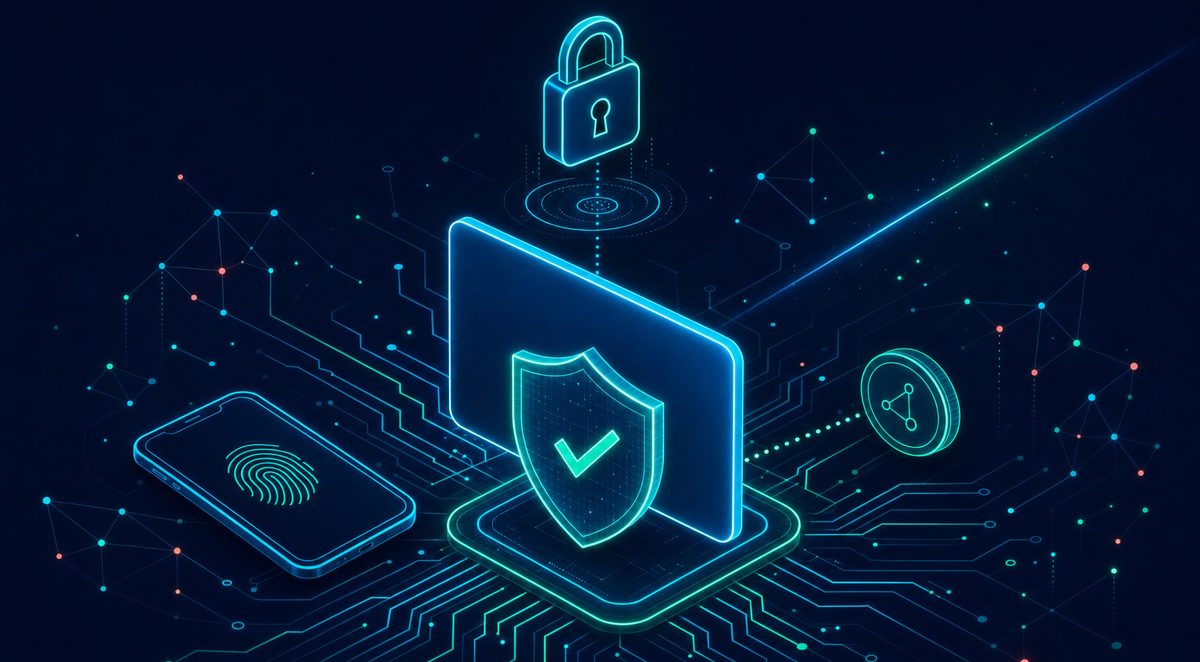
Type in the card number, add the expiry date and security code, confirm briefly in the banking app: paying online with a Visa card rarely takes more than a minute. Several layers of protection work behind that short sequence, and they have changed considerably in recent years. Cardholders should know three of them, because each covers a different risk. 3-D Secure checks who is paying. Tokenisation protects the card data held by the merchant. And the chargeback process applies when something goes wrong anyway.
3-D Secure: Who Is Actually Paying?
3-D Secure is a protocol maintained by the standards body EMVCo, which Visa runs under the name Visa Secure. The name refers to the three domains involved: the cardholder's bank, the merchant's bank and the card network in between. During a payment, the merchant uses this network to ask the card issuer whether the customer really is the legitimate cardholder.
Since the EU's second Payment Services Directive (PSD2) made strong customer authentication mandatory, the bank has to check two independent factors from the categories knowledge, possession and inherence. In practice this usually means approving the payment in the banking app with a fingerprint or face scan, less often a one-time SMS code combined with a password. One detail matters here, known as dynamic linking: the approval is valid only for this exact amount and this exact payee.
Not every payment triggers a prompt. The current protocol version sends the bank a large set of context data, for example about the device and the order. If the bank rates the risk as low, the payment goes through without a challenge. Small amounts under 30 euros and recurring charges can also be exempt. A missing prompt is therefore no sign of an unsafe site.
Tokenisation: The Card Number Stays at Home
3-D Secure protects the moment of payment. Tokenisation starts earlier, with the question of where the card number is stored in the first place. Instead of the 16-digit number, the merchant or the smartphone receives a substitute value, the token. It looks like a card number but works only in a defined context: with one particular merchant, on one particular device or in one particular wallet.
The security benefit shows in a data breach. If attackers steal a shop's customer database and it contains only tokens, they cannot use them with other merchants. With Apple Pay and Google Pay, every payment also carries a cryptogram that is valid once. There is a practical side effect for customers: when a card is replaced, the card network can update the token in the background, and stored payment details keep working.
Cards, Entertainment, Gambling: Where a Closer Look Pays Off
Technical protection does not replace checking the provider. That applies above all wherever money is deposited into a customer account, such as brokers, crypto exchanges or gambling sites. German-language comparison pages list online casinos with Visa together with the limits and fees that apply to card deposits. Whether a provider holds a German permit can also be checked against the whitelist of the Joint Gambling Authority of the German states (GGL). Anyone who approved a deposit themselves will generally not get it back later by arguing that the money was lost at play.
Chargeback: The Safety Net After the Payment
Chargeback is the dispute process of the card networks. The card issuer reclaims an amount from the merchant, for example when goods were not delivered, a charge was made twice or the amount differs from what was agreed. It is not a statutory right but a set of rules between banks, merchants and Visa. Deadlines are short, typically up to 120 days. Disputes should therefore reach your own bank quickly and with supporting documents.
A different case is a payment you never authorised. Here the German Civil Code applies: the bank must, as a rule, refund unauthorised payments without delay. Under section 675v of the Civil Code (BGB), it may hold the cardholder liable for no more than 50 euros if the card was lost or stolen. If the bank did not require strong customer authentication, the customer bears no liability unless they acted fraudulently. In cases of gross negligence, such as passing on a one-time code over the phone, the bank can claim the full loss.
Where Attackers Strike Today
Because the technology has improved, fraudsters target the person. We regularly see three patterns in practice:
- Approval phishing: A fake shop or parcel page asks for card details and triggers a real payment in the background. The victim confirms it in the app without reading the amount and payee. More on this in our article on phishing tricks
- Wallet takeover: Attackers add someone else's card to their own wallet and need only a single confirmation code, which they obtain by phone call or text message
- Web skimming: Malicious code injected into the payment form of a genuine shop reads card data as it is typed. Technically this is related to cross-site scripting
Checklist for Cardholders
- Read every approval: The amount and merchant name in the app must match your order. If something is off, decline
- Never pass on codes: Bank staff do not ask for one-time codes or confirmation codes, not even for supposed security checks
- Switch on push notifications: An alert for every card transaction makes misuse visible within minutes
- Use a wallet or a virtual card: This way the real card number reaches as few merchants as possible
- Check the provider: The legal notice, payment methods and domain age reveal a lot, as our guide to recognising fraudulent online providers shows
Frequently Asked Questions
Is a payment without a 3-D Secure prompt unsafe?
Not necessarily. Banks may skip the prompt for low-risk payments, small amounts and recurring charges. If misuse occurs in such a case, the law limits your liability particularly strongly.
Are Apple Pay and Google Pay safer than typing in the card?
In one respect, yes: the merchant receives only a token and never the real card number. In return, the smartphone itself has to be well protected, with a screen lock and current updates.
Can I reverse any payment with a chargeback?
No. The process is meant for clearly defined cases, such as undelivered goods or incorrect charges. Whether a dispute succeeds depends on the card network's rules and on the evidence you can provide.